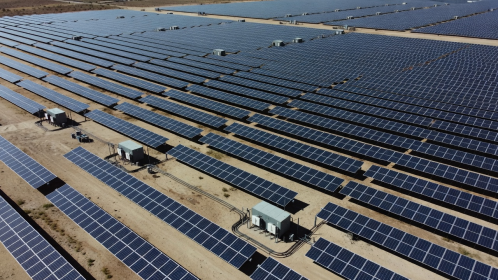
Semiconductor Photovoltaic Mechanisms
Photovoltaic conversion rests upon the internal photoelectric effect within doped semiconductor junctions. When incident photons carry energy exceeding the bandgap of crystalline silicon (approximately 1.1 eV at 300 K), electron-hole pairs are excited across the p-n or n-type heterojunction. An internal electric field drives free electrons toward the negative front contacts and positive holes toward the rear back-surface field, generating direct current (DC).
Utility specifications have largely migrated from traditional Passivated Emitter and Rear Cell (PERC) wafers to Tunnel Oxide Passivated Contact (TOPCon) and Silicon Heterojunction (HJT) architectures. These newer cell technologies feature significantly lower temperature coefficients (approximately -0.26% to -0.30% per degree Celsius rise above 25°C), enabling higher output retention across hot summer daylight peaks.
Single-Axis Tracking vs. Fixed-Tilt Structures
Ground-mounted utility parks choose between fixed-tilt racking structures oriented south (or north in the Southern Hemisphere) and motorized single-axis horizontal trackers (SAT). Trackers rotate east-to-west on torque tubes driven by programmable astronomical algorithms or real-time irradiance sensors.
| System Topology | Annual Energy Yield | Civil / Ground Footprint | Mechanical Vulnerability |
|---|---|---|---|
| Fixed-Tilt (20° – 35°) | Baseline (1.0x) | Dense packing; lower land requirement per MW. | Static; virtually zero moving mechanical failure points. |
| Single-Axis Tracker (SAT) | +15% to +25% Yield | Higher row pitch required to prevent inter-row shading. | Bearings, slew drives, wind stowing controllers subject to wear. |
| Bifacial + SAT Racking | +22% to +32% Yield | Requires elevated torque tube clearance for underside albedo. | Higher structural wind uplift during aerodynamic torsion events. |
DC Voltage Topology and Inversion Strategies
Modern solar plants operate at a nominal 1,500 V DC bus voltage, an advancement over legacy 1,000 V systems that reduces copper and aluminum conductor volumes by up to 30% for identical power transmission. Designers deploy either string inverters (typically 150 kW to 350 kW each distributed along panel rows) or centralized mega-inverters (ranging from 2.5 MW to 4.5 MW housed in dedicated skids).
Central inverters simplify maintenance access by congregating high-power power electronics alongside medium-voltage oil-filled transformers. Conversely, distributed string inverters isolate individual string faults, offering multiple Maximum Power Point Tracking (MPPT) channels that mitigate yield degradation caused by partial cloud soiling or terrain slope variations.
Geographic Context: The Spanish Meseta and Aragón
In high-irradiation semi-arid regions such as Zaragoza and Extremadura in Spain, utility plants leverage high surface albedo from chalky soils. Bifacial installations in these topographies achieve significant underside generation gains when the row spacing is maintained at 6 to 8 meters, which also provides clearance for robotic waterless dry-brush panel cleaning vehicles.
Land Use, Drainage, and Environmental Hydrology
Ground-mount arrays dramatically alter local surface water hydrology. Rainwater sheeting off broad photovoltaic surfaces concentrates run-off along drip lines, leading to potential rill erosion in loose soils. Sustainable project civil design incorporates retention swales, bioswales, and native ground cover grasses beneath panels to stabilize soil and promote groundwater infiltration.
Good For
- Rapid deployment schedules relative to thermal or offshore generation.
- Modular scalability ranging from 5 MW community assets to 500 MW installations.
- Co-location with battery storage (DC-coupled or AC-coupled) to capture clipping losses.
What To Know
- Mid-day production profile requires grid flexibility or storage to prevent curtailment.
- Extensive acreage footprints requiring careful agricultural and biodiversity balancing.
- Module recycling pipelines require specialized chemical delamination facilities.