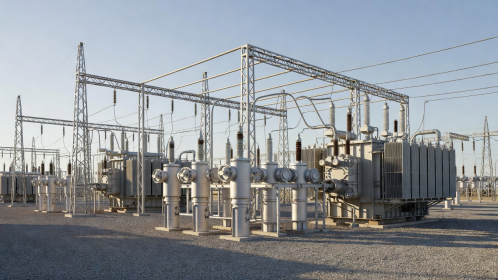
Substation Architecture: Transformation and Protection
High-voltage substations function as the foundational nodes of power systems. Within these secured compounds, power transformers elevate medium voltages delivered by wind and solar arrays (typically 33 kV or 66 kV) to bulk transmission levels—such as 110 kV, 220 kV, or 400 kV. Elevating potential proportionally depresses electrical current for equivalent power transfers, reducing thermal $I^2R$ resistive conductor losses across long geographic transmission corridors.
Substations rely on sophisticated protection schemes comprising current transformers (CTs), potential transformers (PTs), and microprocessor-based numerical relays. In the event of a phase-to-earth fault or lightning strike, relays signal sulfur hexafluoride (SF6) or alternative vacuum-interrupter circuit breakers to physically sever fault currents within 40 to 60 milliseconds, preventing catastrophic transformer winding deformation.
Transmission versus Distribution Networks
Grid operations are split between high-voltage bulk transmission networks (managed by Transmission System Operators, TSOs) and regional distribution systems (managed by Distribution System Operators, DSOs).
| Network Category | Voltage Range | Typical Equipment | Renewable Role |
|---|---|---|---|
| Transmission (Bulk Grid) | 110 kV – 400 kV+ | Steel lattice pylons, autotransformers, gas-insulated switchgear (GIS). | Interconnects GW-scale offshore wind farms and trans-boundary HVDC export lines. |
| Primary Distribution | 11 kV – 33 kV | Pad-mount transformers, vacuum reclosers, underground ring mains. | Accepts commercial rooftop solar, small ground-mount arrays, and local battery hubs. |
| Secondary Distribution | 230 V / 400 V | Pole-top transformers, low-voltage fuse pillars. | Final delivery to domestic and light commercial retail consumers. |
HVDC Transmission: Point-to-Point Bulk Routing
While alternating current (AC) is standard for short and medium distances, AC cables suffer severe capacitive reactive charging currents when laid subsea or underground over distances exceeding 60 to 80 kilometers. Beyond this threshold, charging current consumes cable ampacity, leaving no capacity for active power transport.
High-Voltage Direct Current (HVDC) eliminates continuous dielectric cycling losses. Modern HVDC links deploy Voltage Source Converters (VSC) with Insulated Gate Bipolar Transistors (IGBTs). VSC-HVDC stations independently control active and reactive power without relying on a strong receiving AC grid, enabling black-start stabilization and asynchronous interconnection between non-synchronized national grids (such as the Nordic synchronous zone and Continental Europe).
Regional Interconnection: The Baltic Sea & North Sea Links
Industrial corridors between Rotterdam, Hamburg, and the Baltic ports of Klaipėda and Tallinn highlight cross-border grid integration. Interconnectors like NordLink and Baltic Cable employ ±525 kV extruded XLPE DC cables, allowing hydro-generation in Scandinavia to instantaneously balance wind lulls across the North German plain.
Grid Inertia and Synchronous Condensers
As legacy coal and nuclear thermal power stations retire, power systems lose physical rotational inertia. Massive spinning turbine rotors naturally resist abrupt frequency shifts caused by instantaneous demand spikes or tripping power lines. In response, transmission utilities are deploying heavy, de-clutched synchronous condensers—essentially large spinning electric motors connected to flywheels—to inject fault current and rotational inertia into converter-dominated grids without burning fuel.
Good For
- Transporting thousands of megawatts over hundreds of kilometers with minimal losses.
- Isolating regional grid disturbances to prevent cascading continental blackouts.
- Providing dynamic reactive power compensation via STATCOMs to maintain voltage profiles.
What To Know
- New transmission corridors encounter multi-year planning and right-of-way permitting.
- SF6 gas switchgear requires strict environmental leak containment and transition to fluoronitrile alternatives.
- Interconnection queues for renewable projects currently average 3 to 7 years in mature markets.